
Pacific Beach Short-Term Rental Guide
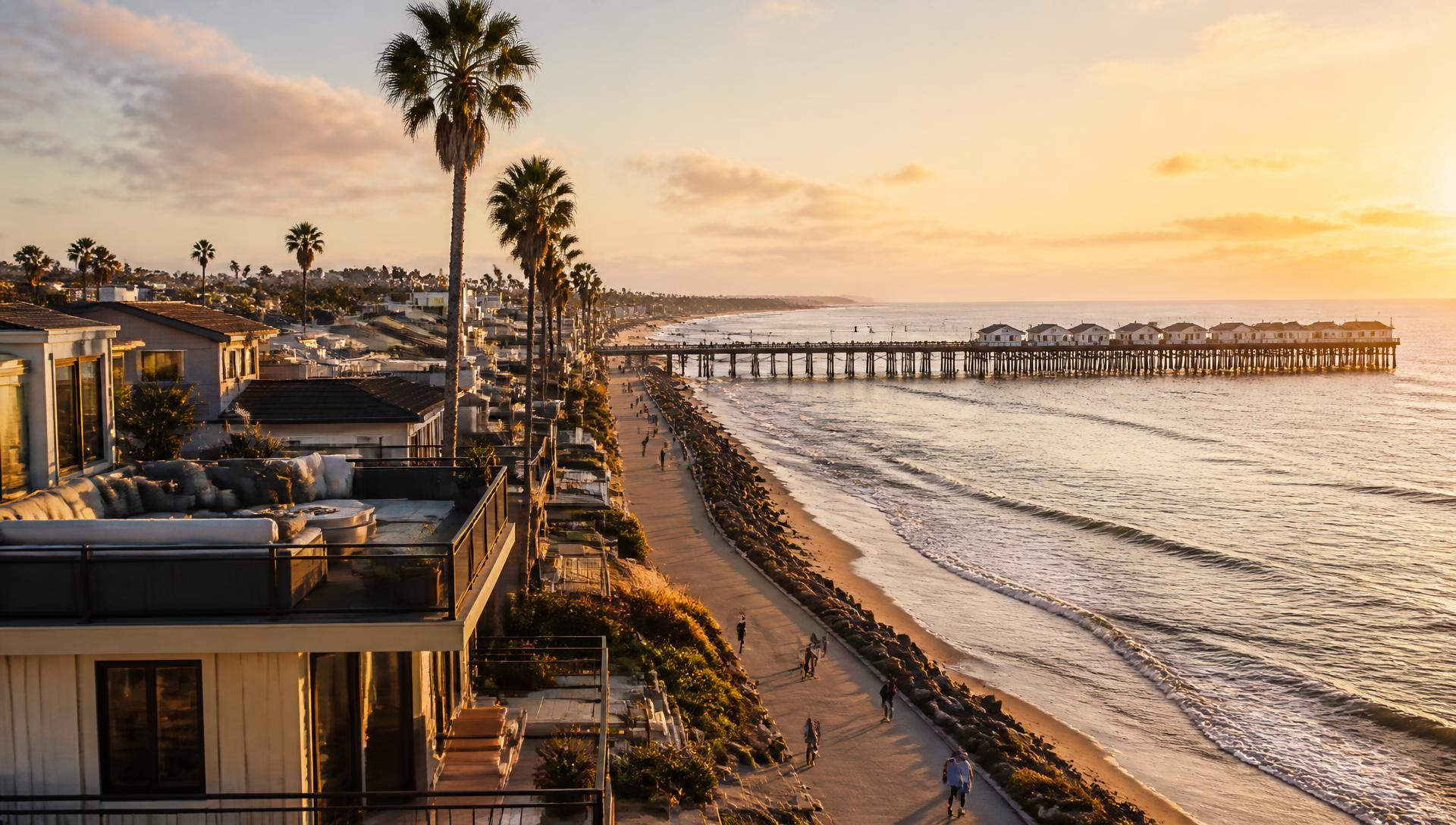
Pacific Beach is a City of San Diego coastal neighborhood with two waterfronts: the oceanfront boardwalk to the west, and Sail Bay and Crown Point to the south. Crystal Pier's 1927 cottages sit over the water at the foot of Garnet Avenue. Whole-home short-term rentals here draw from the citywide Tier 3 license pool — capped at 1% of San Diego's housing stock, and still open as of 2026. This guide covers the demand, the performance drivers and the licensing realities that price a deal.
Whole-home licenses for Pacific Beach come from the citywide Tier 3 pool.
Of San Diego's housing stock (roughly 5,400 Tier 3 licenses); capacity remained as of 2026.
Whole-home STRO licenses citywide.
People in the five nearest counties: San Diego 3.28M · LA 9.69M · Orange 3.15M · Riverside 2.54M · San Bernardino 2.22M
Cottages over the water at the foot of Garnet Avenue.
The boardwalk to the west; Sail Bay and Crown Point to the south.
Summer peak, with an event-and-nightlife floor the rest of the year.
Why Pacific Beach for Short-Term Rental
Tier 3 coast, while capacity lasts.
Winter
- Value season
- Mild 60s days
- Nightlife-weekend floor
- Monthly stays (31+ days)
Spring
- Spring break
- Bay season opens
- Shoulder pricing
- Graduations
Summer
- Peak beach weeks
- Boardwalk and pier crowds
- Bay-side family stays
- July 4th premium
Fall
- Second summer (Sep)
- Warmest water
- Quieter weeks
- Thanksgiving
Relative Revenue by Month
Relative market seasonality only — not a dollar revenue forecast for any specific property.
Summer is the strongest season on peak beach weeks, boardwalk and pier crowds, bay-side family stays and a July 4th premium; September holds a second summer with the warmest water, spring builds through break weeks and graduations, and mild 60s winters set a value-season floor for 31-plus-day stays.
Tier 3 still has room
Unlike Mission Beach's full Tier 4 pool, whole-home Tier 3 licenses remained available in 2026. The count only moves one direction; early licensees inherit the moat.
One license per host, non-transferable
Licenses are personal, natural-person-held and die at sale. Decide who applies, and structure title and the application before escrow closes, not after.
Nightlife side vs family side
Garnet-adjacent blocks book loud and risk complaints that endanger a license; Crown Point and Sail Bay book families and repeat weeks. Same tier, different risk profiles.
Two-night minimum, summer-weighted
High-turn Sat-to-Sat weeks in summer; events, conferences and mild winters fill the floor.
The license countdown is the thesis
When Tier 3 hits its cap, Pacific Beach converts to Mission-Beach-style scarcity: lotteries and waitlists. Buying and licensing while capacity remains is the trade; underwrite the no-license case (monthly rental) as the honest downside.
What Drives STR Performance in Pacific Beach
Rank every property against these factors.
Walk to sand or bay
Blocks-to-water is the rate curve; west of Mission Blvd is its own class.
Bay-side calm
Crown Point and Sail Bay book families, paddleboards and repeat summers.
Rooftop and view decks
The listing hero for the beach-block housing stock.
Sleeps count
Verify legal bedrooms; sleeper design decides group capacity.
Parking
Scarce and priced; off-street spaces are revenue.
Garnet proximity, tuned
Walkable-to-dinner sells; door-to-bar can cost you the license.
Outdoor shower
Sand management earns reviews.
Bikes and boards
Expected inventory on the boardwalk.
AC and soundproofing
August comfort and quiet-hours compliance in one line item.
Fast Wi-Fi
Shoulder-season remote work extends the calendar.
Photography quality
A pricing input, not a nicety.
Complaint-proof ops
Noise history endangers a capped license; run it clean.
Pacific Beach: Tier 3 vs. Tiers 1 and 2
Same ordinance, three ways in.
Whole-home investor rentals need a capped Tier 3 license. Hosted paths (Tier 1 part-time, Tier 2 home share) are uncapped and pair well with owner-occupied duplexes and ADU-era properties.
Match the license tier to how the property will really run, and verify current capacity before you write the offer.
How Do the STRO Tiers Compare in Pacific Beach?
Entire dwelling, more than 20 nights per year, host not present.
Tier 1: whole or part, 20 nights or fewer per year · Tier 2: home share while the host resides on site.
1% of citywide housing (about 5,400); capacity remained in 2026.
Uncapped.
About $1,170 total, two-year term.
Tier 1 about $226; Tier 2 about $317.
2 nights.
Not applicable to hosted stays.
NO · personal and non-transferable.
Same: licenses do not convey.
Dedicated investment homes and second homes.
House hackers, duplex owners, pre-2018 ADU configurations.
City TOT by zone (11.75%–13.75%) plus assessments.
Same structure.
The scarce asset; apply early and protect it.
The uncapped on-ramp while you wait or test the market.
Jurisdiction is a parcel-level fact: confirm the zone, the permit history and any private restrictions before underwriting.
What a Buyer Must Know
Not the whole ordinance. The parts that price a deal.
Get the license before the cap gets it first.
Tier 3 is first-come while capacity lasts, personal to the host, and non-transferable at sale. The operating rules are ordinary; the scarcity is not.
File the TOT certificate, the application and the Good Neighbor acknowledgments as one coordinated closing workstream.
What Does It Take to Start Renting in Pacific Beach?
City of San Diego · Tier 3 STRO License
- Confirm the tier the property needsWhole-home investor rentals need a capped Tier 3 license; hosted paths (Tier 1 part-time, Tier 2 home share) are uncapped.
- Verify current Tier 3 capacityTier 3 is first-come while under the 1% citywide cap (about 5,400 licenses); capacity remained in 2026, and oversubscription goes to lottery.
- Obtain a TOT certificateA transient occupancy tax certificate is a prerequisite to the STRO license.
- File the application and acknowledgmentsNatural persons only, one license per host, tied to the dwelling. File the application and the Good Neighbor acknowledgments as one coordinated closing workstream.
- Pay the license feeAbout $1,170 total for a two-year term.
- Operate and remitLicense number in every advertisement, 24/7 local contact, good-neighbor and trash standards, and monthly TOT remittance including zero months.
The license ends with the sale and cannot be inherited by a buyer. Once Tier 3 reaches the 1% cap, entry depends on a published window and lottery, and the dark period becomes indefinite.
Stays of 31-plus days are the no-license fallback. Tier 1 (20 nights or fewer per year) and Tier 2 (home share) remain uncapped, so a resident host has paths a whole-home investor does not.
Buying and licensing while Tier 3 capacity remains is the trade. Underwrite the no-license case as the honest downside.
Timelines above are approximate estimates based on the supplied research and reflect rules in effect September 2026. Confirm current requirements before underwriting.
Is Short-Term Rental Licensing Required in Pacific Beach?
Yes — a Tier 3 whole-home STRO license, two-year term, about $1,170, natural persons only. The comparison below sets the Tier 3 rules alongside the citywide obligations that still apply.
YES · Tier 3 whole-home license, two-year term, about $1,170; natural persons; one per host; tied to the dwelling.
TOT certificate first; license number in every advertisement.
First-come while under the 1% citywide cap; lottery if oversubscribed.
Tier 1 and Tier 2 remain uncapped.
NO · the license ends with the sale.
A revoked license carries a 12-month reapplication bar.
2 nights for whole-home rentals.
Nightly and booking reporting obligations apply.
Good-neighbor policy, occupancy and trash standards, 24/7 local contact.
Fines up to $1,000 per day unlicensed; platforms must delist.
City TOT by zone (11.75%–13.75%) plus applicable assessments; confirm the parcel's zone.
Monthly remittance including zero months.
ADUs permitted before Oct 15, 2017 can qualify; later ADUs cannot.
Verify permit dates before counting ADU income.
Dark period: application processing while capacity lasts; indefinite after the cap.
31-plus-day stays are the no-license fallback.
Rates and requirements above are drawn from the supplied research and should be confirmed with the City Treasurer before underwriting.
What Are the License and Stay Rules for a Pacific Beach STR?
ADUs permitted before Oct 15, 2017 can qualify; later ADUs cannot. Verify permit dates before counting ADU income.
Good-neighbor policy, occupancy and trash standards and a 24/7 local contact apply, the license number goes in every advertisement, and nightly and booking reporting obligations continue year-round.
Fines run up to $1,000 per day for unlicensed operation and platforms must delist. A revoked license carries a 12-month reapplication bar — noise history endangers a capped license, so run it clean.
Pacific Beach STR Licensing FAQ
Whole-home investor rentals in Pacific Beach need a Tier 3 STRO license from the City of San Diego — a two-year term costing about $1,170, issued to natural persons, one per host, and tied to the dwelling. A transient occupancy tax certificate is a prerequisite and the license number must appear in every advertisement.
As of 2026, yes. Tier 3 is capped at 1% of San Diego's housing stock — roughly 5,400 licenses — and capacity remained. Licenses are issued first-come while under the cap, with a lottery if applications oversubscribe. The count only moves one direction, so early licensees inherit the moat.
Pacific Beach draws from the citywide Tier 3 pool, capped at 1% of housing stock and still open in 2026. Mission Beach has its own Tier 4 pool at roughly 30% of dwellings, which is fully subscribed. Same ordinance, different queues: Pacific Beach is the market where a buyer can still license today.
No. STRO licenses are personal, held by natural persons, and end with the sale. Decide who applies and structure title and the application before escrow closes, not after.
Two nights for whole-home rentals citywide. Summer runs on high-turn Saturday-to-Saturday weeks, and events, conferences and mild winters fill the floor the rest of the year.
Tier 1 covers whole or partial rentals for 20 nights or fewer per year (about $226); Tier 2 covers a home share while the host resides on site (about $317). Both are uncapped, making them the on-ramp for house hackers, duplex owners and pre-2018 ADU configurations while a buyer waits or tests the market.
City transient occupancy tax by zone, ranging from 11.75% to 13.75%, plus applicable assessments. Confirm the parcel's zone and remit monthly, including zero-revenue months.
Only if it was permitted before October 15, 2017. ADUs permitted after that date cannot qualify, so verify permit dates before counting ADU income in a pro-forma.
Blocks-to-water is the rate curve, and west of Mission Blvd is its own class. Garnet-adjacent blocks book loud and risk complaints that endanger a license; Crown Point and Sail Bay book families, paddleboards and repeat summer weeks. Same tier, different risk profiles.
Fines run up to $1,000 per day for unlicensed operation and platforms must delist unlicensed listings. A revoked license carries a 12-month reapplication bar. Good-neighbor policy, occupancy and trash standards, a 24/7 local contact and nightly booking reporting all apply.
Buying and licensing while Tier 3 capacity remains is the trade, so underwrite the no-license case — monthly rental at 31-plus days — as the honest downside. When Tier 3 hits its cap, Pacific Beach converts to Mission-Beach-style scarcity: lotteries and waitlists.
June through August, on peak beach weeks with boardwalk and pier crowds, bay-side family stays and a July 4th premium. September brings a second summer with the warmest water, spring builds through break weeks and graduations, and mild 60s winters set a value-season floor.
License While the Capacity Lasts
We help buyers look beyond the listing and evaluate Tier 3 capacity, the hosted tiers, transfer rules, the 31-plus-day fallback, and short-term rental opportunity before making a decision.
Sources & Regulatory Notes
- San Diego Municipal Code §510 — Short-Term Residential Occupancy (STRO)
- City Treasurer STRO program pages — tier statistics, fees and application windows
- City of San Diego transient occupancy tax program — zone rates
Summary prepared September 2026 from official sources; rules change and this is not legal advice. Verify jurisdiction, zoning, permit status and taxes parcel by parcel before underwriting.