
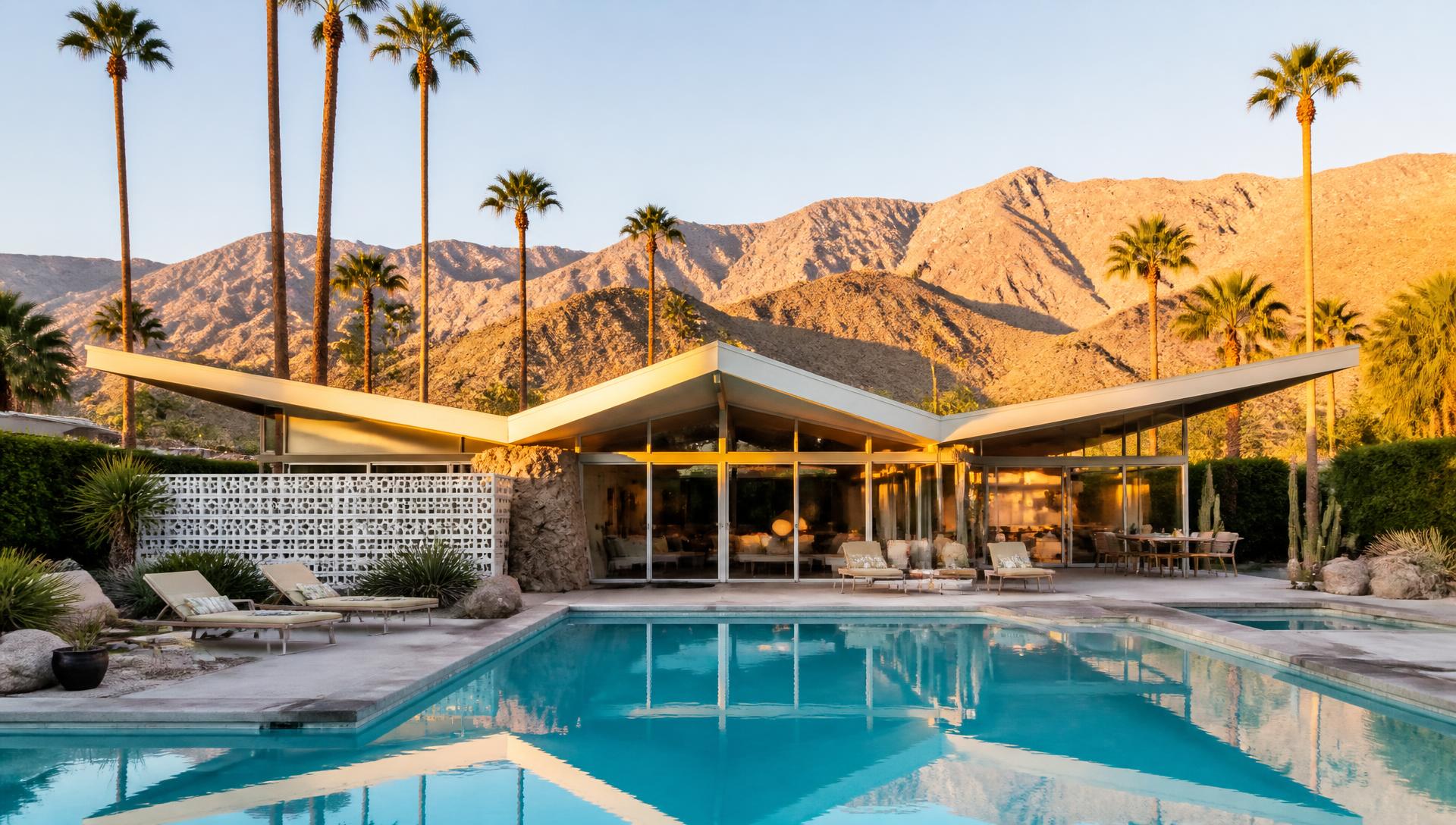
Palm Springs Short-Term Rental Guide
Palm Springs is the design capital of the desert and the valley’s strongest short-term rental brand, operating under its strictest program. Certificates are capped per neighborhood, limited to one per person, and they end at the sale, so eligibility — not the house — sets the ceiling on value. This guide covers the demand, the performance drivers and the licensing realities that price a deal.
City of Palm Springs, 2020 Census.
Greater Palm Springs, destination-reported; treat as directional.
Winter-peak resort weather; summer is the value season.
People in the five nearest counties: LA 9.69M · San Diego 3.28M · Orange 3.15M · Riverside 2.54M · San Bernardino 2.22M
Aerial Tramway from desert floor to alpine forest.
Modernism Week each February; the world's densest midcentury housing stock.
One long high season; the deepest trough lands in July and August.
Why Palm Springs for Short-Term Rental
Design capital, winter peak.
Winter
- Film festival and snowbirds
- Modernism Week (Feb)
- Pool-warm afternoons
- Peak pricing
Spring
- Festival spillover
- Tennis in Indian Wells
- Warm evenings
- Strong shoulder pricing
Summer
- Deep value season
- 110°F stretches
- Locals' hotel deals to beat
- Misting and pools required
Fall
- Pride (Nov)
- Season restart
- Comfortable evenings
- Events return
Relative Revenue by Month
Relative market seasonality only — not a dollar revenue forecast for any specific property.
Winter is the strongest season, spring holds as a strong shoulder, summer heat is the trough, and fall recovers as events return.
A 20.9-million-person drive market
Plus a real fly-in market through PSP. Winter demand is national, not just regional.
The certificate is the asset
One certificate per person, neighborhood caps at 20%, and certificates do not transfer on sale. Eligibility, not the house, sets the ceiling on value.
Contract math replaces turn count
Bookings are capped per calendar year (26 contracts for new certificates; one booking equals one contract). ADR and length of stay carry revenue here.
Winter carries the year
January through April does the heavy lifting; buy homes that photograph like February.
Verify the neighborhood before the house
Roughly a sixth of Palm Springs' organized neighborhoods sit at or over the 20% vacation-rental density cap. Buying in a capped neighborhood means a waitlist, not a permit, and applications are not accepted while a property is in escrow. The density map is due diligence item number one.
What Drives STR Performance in Palm Springs
Rank every property against these factors.
Pool and heated spa
The non-negotiable pair; heating decides the shoulder months.
Midcentury pedigree
Alexander-era bones and honest restorations command the premium.
Mountain views
The San Jacinto backdrop is the hero shot of this market.
Design and photography
Guests shop this market like a design magazine; shoot it that way.
Outdoor rooms
Firepit, dining and lounging: winter evenings live outside.
Shade and misting
Keeps May and October working at full rate.
Walk to the strip
Uptown Design District and Palm Canyon walkability converts bookings.
Casita and bonus space
Separate-key space wins couples' trips and long stays.
Bedroom count
With contract caps, sleeps-count times ADR is the equation.
Parking
Off-street capacity, quietly enforced.
Pet friendly
Widens the funnel in a drive-to market.
Compliance readiness
Meet-and-greet rules, postings and response times: this city checks.
Palm Springs vs. Cathedral City
Neighbors with opposite verdicts on the same business.
Palm Springs voters kept vacation rentals in 2018 and the city now licenses them harder than almost anywhere in the valley. Cathedral City phased non-hosted STRs out of most residential zones, leaving hosted stays and certain HOA resort communities.
Confirm the city, the organized neighborhood, and its cap status parcel by parcel.
How Do Palm Springs and Cathedral City STR Rules Compare?
Incorporated city; dedicated Vacation Rental compliance department.
Incorporated city.
Vacation Rental Registration Certificate · Municipal Code Ch. 5.25 (Ords. 1918, 2075, 2133).
Non-hosted STRs phased out of most residential zones; hosted and certain HOA communities excepted.
No · the certificate ends with the sale; the buyer applies fresh, or joins a waitlist in capped neighborhoods.
No path for new non-hosted rentals.
20% of units per organized neighborhood; one certificate per person; Junior certificate (6 contracts) sits outside the cap.
Not applicable.
26 for new certificates; existing permittees grandfathered at higher counts; one booking equals one contract.
Not applicable.
2 guests per bedroom, up to 8 adults plus 2 children under 12.
Legacy rules for excepted uses.
11.5% TOT plus 1% Greater Palm Springs TBID.
City TOT on hosted stays.
The valley's strongest brand and ADR, under its strictest program.
Not a whole-home STR market; long-term rental math instead.
Jurisdiction, neighborhood and cap status are parcel-level facts: confirm them with both cities before underwriting.
What a Buyer Must Know
Not the whole ordinance. The parts that price a deal.
No certificate, no business. And the certificate does not transfer.
Palm Springs accepts applications only after close of escrow (not during), issues one certificate per person, and closes neighborhoods that reach the 20% density cap. A purchase in a capped neighborhood buys a waitlist position, not a rental business.
Model the dark period, and model the possibility it never opens.
How Long Does It Take to Get a Palm Springs Vacation Rental Certificate?
City of Palm Springs · Vacation Rental Compliance
- Check the density mapConfirm the organized neighborhood's cap status before writing the offer.
- EscrowApplications are not accepted while a property is in escrow.
- Close of escrowThe seller's certificate ends with the sale; apply as a new applicant.
- ApplicationVacation Rental Registration Certificate, about $1,046 per year.
- City reviewApprovals commonly run 30–90 days.
- Certificate issued26 contracts per calendar year for new certificates.
Indefinite in a neighborhood already at the 20% cap.
Vacation rentals are capped at 20% of units per organized neighborhood, and per the supplied research roughly a sixth of the city’s organized neighborhoods sit at or over that line. Junior certificates, limited to 6 contracts per year, sit outside the cap.
Check the density map before writing the offer — in a capped neighborhood the application is a waitlist position, not a permit.
Timelines and fees are approximate estimates based on the supplied research. They are not guaranteed approval times, and individual applications can take longer.
Is Short-Term Rental Licensing Required in Palm Springs?
Yes. An annual Vacation Rental Registration Certificate is required under Municipal Code Ch. 5.25 and applies to single-family homes. The comparison below sets the Palm Springs program alongside Cathedral City next door.
Yes · Vacation Rental Registration Certificate, annual (about $1,046 per year); single-family homes only.
Hosted-only registration in most residential zones.
No · applications are not accepted while in escrow; the buyer applies after close; capped neighborhoods go to a waitlist.
No new non-hosted certificates.
20% per organized neighborhood; one certificate per person; Junior certificates (6 contracts per year) outside the cap.
Non-hosted use phased out.
26 for new certificates; one booking equals one contract, and unpaid stays count when the owner is absent.
Not applicable.
2 per bedroom, up to 8 adults plus 2 children under 12.
Legacy rules.
In-person meet-and-greet requirements, posted rules, strict response standards; the city publishes suspensions.
Complaint-driven enforcement.
Dedicated compliance department; fines, suspensions and advertising bans; hotline-monitored.
Citations for unhosted operation.
11.5% TOT plus 1% GPS TBID; monthly filings including zero months.
City TOT on permitted hosted stays.
About $1,046 per year; approvals commonly 30–90 days · practical dark period 1–3 months in open neighborhoods, indefinite in capped ones.
Not applicable for whole homes.
Fees, tax rates and timelines above are drawn from the supplied research and should be confirmed with each city.
What Are the STR Occupancy Rules in Palm Springs?
Counts follow the ordinance formula. Because contract counts are capped, bedroom count paired with achievable ADR is the revenue equation.
New certificates are limited to 26 contracts per calendar year, where one booking equals one contract and unpaid stays count when the owner is absent. Existing permittees are grandfathered at higher counts.
In-person meet-and-greet requirements, posted rules and strict response standards apply, and the city’s dedicated compliance department publishes suspensions.
Palm Springs STR Licensing FAQ
Yes. Palm Springs requires an annual Vacation Rental Registration Certificate under Municipal Code Ch. 5.25 (Ords. 1918, 2075, 2133), at about $1,046 per year, and it applies to single-family homes. The city runs a dedicated Vacation Rental compliance department with fines, suspensions and advertising bans, and it publishes suspensions.
No. The certificate ends with the sale and the buyer applies fresh. Applications are not accepted while a property is in escrow, so a buyer applies only after close — and in a neighborhood at the density cap, that application becomes a waitlist position rather than a permit.
Vacation rentals are capped at 20% of units per organized neighborhood. Per the supplied research, roughly a sixth of the city's organized neighborhoods sit at or over that cap. Junior certificates, limited to 6 contracts per year, sit outside the cap. Checking the city's density map is due diligence item number one.
New certificates are limited to 26 contracts per calendar year, where one booking equals one contract and unpaid stays count when the owner is absent. Existing permittees are grandfathered at higher counts. Because turn count is capped, ADR and length of stay carry revenue in this market.
Per the supplied research, approvals commonly run 30–90 days, making the practical dark period roughly 1–3 months in open neighborhoods. In capped neighborhoods it is indefinite: model the possibility that it never opens. These are approximate estimates, not guaranteed approval times.
Overnight occupancy is 2 guests per bedroom, up to 8 adults plus 2 children under 12. With contract counts capped, bedroom count paired with achievable ADR is the revenue equation rather than turnover.
An 11.5% transient occupancy tax plus a 1% Greater Palm Springs TBID assessment applies, with monthly filings required including zero months.
Palm Springs voters kept vacation rentals in 2018 and the city now licenses them harder than almost anywhere in the valley. Cathedral City phased non-hosted short-term rentals out of most residential zones, leaving hosted stays and certain HOA resort communities, so it is generally not a whole-home STR market. Confirm the city, the organized neighborhood and its cap status parcel by parcel.
Check the Cap Before You Write the Offer
We help buyers look beyond the listing and evaluate neighborhood cap status, the certificate path, contract limits, occupancy rules and short-term rental opportunity before making a decision.
Sources & Regulatory Notes
- Palm Springs Municipal Code Chapter 5.25 (Ords. 1918, 2075, 2133)
- City of Palm Springs Vacation Rentals program — fees, density map, contract-limit updates
- City of Palm Springs vacation rental governance updates and published suspensions
- Cathedral City municipal code and STR program history
- U.S. Census Bureau, 2020 Census — City of Palm Springs population
Summary prepared September 2026 from official sources; rules change and this is not legal advice. Verify jurisdiction, zoning, permit status and taxes parcel by parcel before underwriting.